
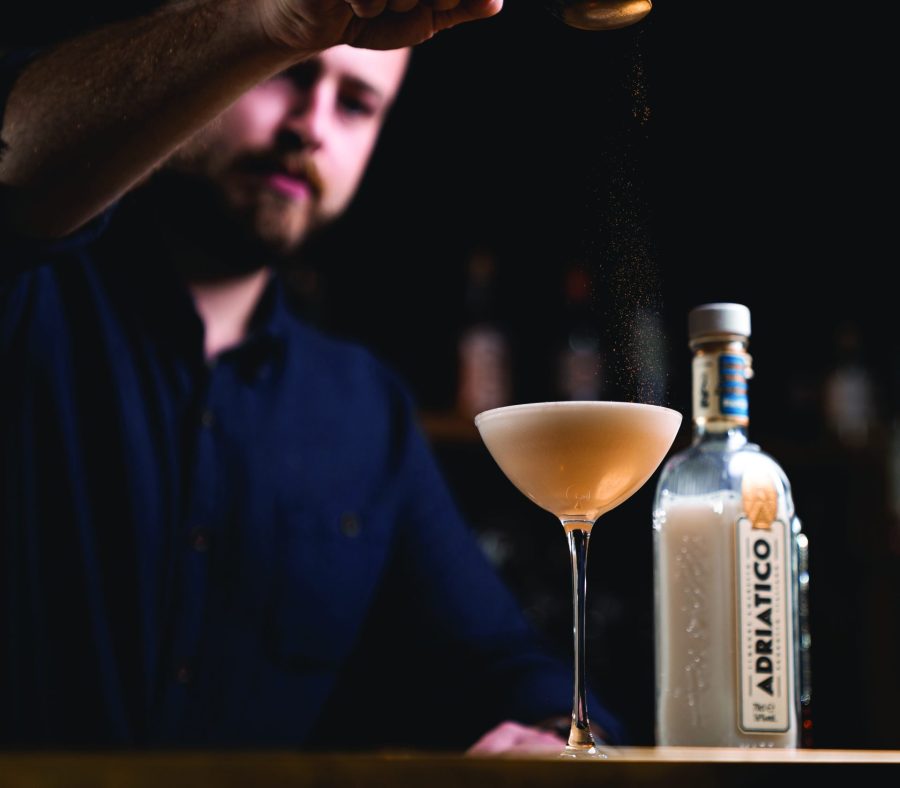
Few brands have innovated a traditional spirits market more than Amaretto Adriatico. Founder Jean-Robert Bellanger shares his insights with Shay Waterworth
Last year Eleanor Yates reported on a new wave of premium amarettos hitting the market. Brands from Australia, the US and France are challenging the perceptions of a classic Italian liqueur category, but they’re following in the footsteps of Adriatico.
The brand launched in 2019 using almonds from Puglia, and it now has three products in its core range, which are sold in 40 countries. Founder Jean-Robert Bellanger tells Drinks International: “When we launched in 2019 we didn’t want to compete with another brand, we wanted to show the world that amaretto could be different. We’re fighting against the digestivo, we don’t want amaretto to be the forgotten spirit at the end of a meal.”
The three products in the range are the original Roasted, Bianco crème liqueur and Zero alcohol free. Bellanger recently featured on the Maffeo Drinks podcast, saying: “It can be difficult entering new markets because we carry a higher price point than other amaretto brands, especially in today’s economic climate.
“That’s why you need a distinct product. Bianco is unique on the market and has no competitors, Zero has almost no competition regarding quality and Roasted has competition, but it’s different. You also need to have a competitive price and be working in the field.”
Adriatico Zero was introduced in late 2025 and, according to Bellanger, it already represents nearly 30% of the brand’s turnover.
“The Zero is touching another set of customers. Every bar now needs to integrate a non-alcoholic drinks menu. People drinking non-alcoholic cocktails don’t want fancy drinks where they don’t know what it will taste like, they want the basics but without the alcohol. Amaretto Sour without alcohol – everyone will understand it.”
Different markets
Offering diversity is important, especially when entering a variety of markets. According to Bellanger, amaretto is treated very different domestically compared to its export markets.
“In Italy it’s largely seen as a digestive after dinner and used in cooking, but less so in cocktails. The largest market globally is the US because of the Amaretto Sour.
“[That’s why] I’ve changed my strategy in Italy over the past five years. We are in all the best five-star hotels and bars around Italy, but I guess targeting foreigners rather than locals.”
From a brand-building perspective, especially for new players in traditional spaces, Bellanger puts a lot of value in the role of distributors.
“Distribution is everything,” he says. “You can have the best product in the world but without a good distributor and people in the field to push it, it’s useless.
“It’s also important to realise that you’re going to find very few distributors who are brand builders. I could name very few who will import, distribute and brand build because usually they have lots of brands [in their portfolio].
“Every distribution company will have something like a soda brand which will make 30%, a gin brand and a whisky brand, then the rest of the portfolio look beautiful but are not effective.”
Bellanger tries to use this model to his advantage. He looks at the biggest brand in the distribution company he’s working with and makes a cocktail with that.
“Then the sales teams working for the distributor will sell both products without you needing to.”
Brand collaboration has been another tactic used by Adriatico. Over the six years on the market the brand has collaborated with other brands such as Heaven Hill and Maison Ferrand to launch a series of limited-edition barrel-aged amaretto.
Bellanger says: “I always loved barrel-aged spirit, and I wanted to try it with amaretto because it had never been done before. At Bar Convent Berlin back in 2019, the Heaven Hill brand ambassador loved the product and offered to give us some barrels to age it in. We gave it a try and it was fantastic. In 2021 we launched the first limited edition and all 900 bottles sold out in a week.”
But for the Frenchman it isn’t enough to stay in one lane – collaborations across different industries have proven fruitful for the brand.
“Our latest collaboration is with a Swiss chocolate brand called Gold Cane which launched a chocolate infused with Roasted and it’s very successful in airport duty free. That’s growing awareness through a different industry in a different market.
“Our main focus now is on the three SKUs and holding out in the US.”
